

The breakpoint
What Britain's buckling health system portends for the United States


Harriet Hawkins never cried.
Nine hours before she was born the midwife called the consultant obstetrician. Her heartbeat was gone. On the seventeenth of April, 2016, at Nottingham City Hospital, they wrapped Harriet in a white cotton blanket and then placed her, lightly, into her mother Sarah’s heavy arms.
At first, the hospital told Sarah her daughter died of an infection.
“A full-term, healthy baby doesn’t just die,” Sarah said.
Learning what actually happened would take ten years, public outcry, and the largest independent maternity investigation in NHS history.
The Nottingham Ockenden Report, released this June, described baby Harriet as the “signature case,” one of 162 avoidable deaths at the same hospital. It found no infection, and no cause of death at all. It only found that Sarah and her husband called the hospital repeatedly and were turned away, leaving her labor unmonitored.
It was the fourth such investigation over the last decade. First came the review of the deaths at Morecambe Bay. After that, Shrewsbury and Telford, and then East Kent. Each investigation found similar patterns: delays in care, poor communication, inadequate staffing and beds.
Across all the investigations, the reviewers issued 756 recommendations. But each time the press and public settled on a single culprit: midwives, and their pursuit of “normal birth at any cost.”
The phrase came from an offhand comment in the Morecambe Bay report, the first of the investigations, and it appeared in none of its actual recommendations. Yet it came to define an entire era of NHS maternity policy.
The reckoning
The first time I witnessed childbirth was also my first week working in a hospital. It was 2006, and I was a medical student assigned to the night shift at Women and Infants Hospital in Providence, one of the busiest maternity units in the United States. The average American is born at a hospital that delivers 500 babies a year. Women and Infants delivers 10,000.
The unit was staffed with midwives, an exception in America that was born partly of necessity. Rhode Island’s beds were full and its budgets thin, and someone had figured out, decades earlier, that midwives could safely absorb the volume a small state’s obstetricians could not. Most of the women I helped care for that year gave birth without an obstetrician in the room. Almost none of them needed one.
Midwives taught me how to stop a hemorrhage. How to suture. How to relieve a shoulder caught in the birth canal. How to sit at the bedside and coach, as a mother pushed her baby’s head forward, millimeter by millimeter, needing my solidarity above all else.
What was exceptional in Rhode Island was normal in Britain, and it made the NHS the envy of the world. The World Health Organization backed midwifery-led care. So did the Royal College of Obstetricians and Gynaecologists. So too, for a while, did the results.
Cesarean rates stayed low by international standards, and the same model served every woman in the system for free, rich or poor, native-born or newly arrived. NICE, which sets the NHS’s clinical guidance, went so far as to declare that women with low-risk pregnancies were safer with a midwife than with an obstetrician, who might be more inclined to operate unnecessarily.
But by the mid 2000s the cesarean rate had climbed above 20 percent. In response, the Royal College of Midwives launched a public campaign called “Normal Birth,” aimed not at eliminating intervention but at pushing back against unnecessary medicalization. Its clearest document, a 2008 booklet called Ten Top Tips, opened with a single instruction: wait and see. Women themselves, it argued, were the best source of information about what they needed.
Midwives like Sheena Byrom embodied that campaign.
I’ve spoken with Sheena many times. She talks the way you’d want your favorite aunt to talk, warmly, unhurried, circling a point twice before landing it because she wants you to arrive there with her. After all these years, she still says things like “childbirth is not risk free, but it isn’t a risky business.”
Sheena was among the first consultant midwives to serve in the NHS. When the Normal Birth campaign launched, she had already welcomed thousands of babies. She’d seen firsthand that most women needed attending to, not managing. The campaign gave her national language for a conviction she already held, and she became one of its most visible champions, alongside her research partner, Professor Soo Downe. Together they wrote and edited books, and started an international conference.
“We’ve now gone up from about 25 percent cesarean to 45 percent in the period since the campaign stopped,” she said. “Our maternal mortality has gone up. Our birth trauma has gone up.”
But in 2015, their conviction became a liability. When the first independent investigation into deaths at an NHS trust was published, it described a unit “dominated by a group of midwives whose overzealous pursuit of the natural childbirth approach led at times to inappropriate and unsafe care.” Suddenly, Sheena and Professor Downe found themselves cast as symbols of the very thing the report condemned.
Meanwhile, Downe watched numbers move in the wrong direction. “We’ve gone up from about 25 percent cesarean rate to 45 percent in the period since the campaign stopped,” she said. “Our maternal mortality has gone up. Our birth trauma has gone up.”
Addressing the ICM years later, Downe named the consequences for the midwifery profession. “A few highly influential individuals” had persuaded politicians, journalists, and lawyers “that the reason babies were dying was because midwives were pushing an ideology,” she said, and that conviction “extended to trolling of midwives... undermining their professional and personal credibility.” It had never really been an argument about the evidence at all.
Running on goodwill
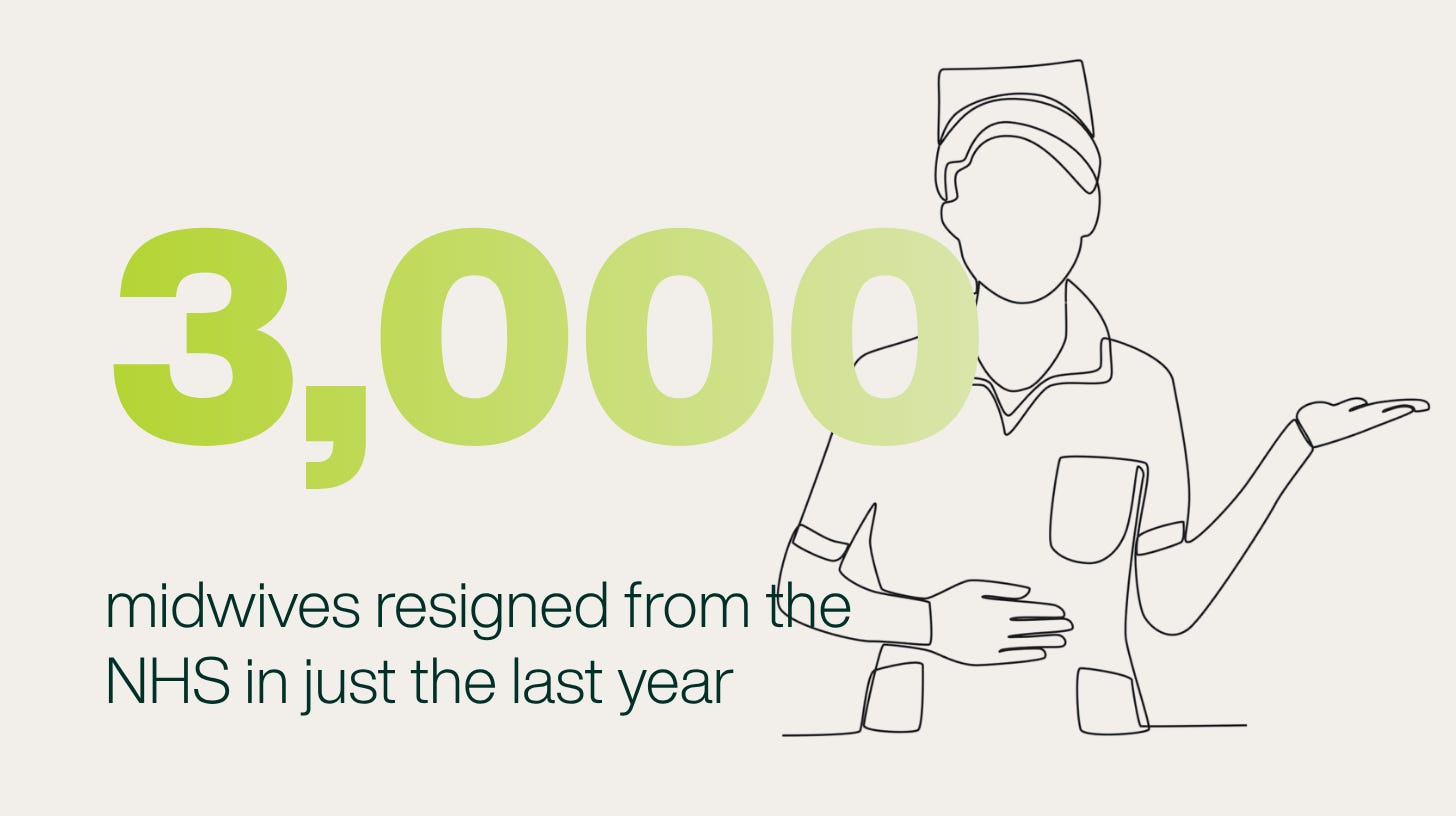
As tragedy dominated headlines, traumatized families campaigned for accountability. Midwives felt targeted, burned out, and displaced. And they left the NHS in droves. Last year alone, nearly 3,000 midwives resigned, half of whom were under the age of 35. Over that same decade, the cesarean rate in England has skyrocketed to nearly half of all births, as if the cure for an ideology were more of everything it opposed.
Dr. Hiba Sher Khan, Maven’s medical director in the UK, practices obstetrics and gynecology in London. She has also given birth herself twice in the last several years, right as conditions inside the NHS deteriorated. What she describes is not an ideology. It is exhaustion. Every time she arrives for a shift, she does a kind of triage before she has even touched a patient.
“When I come on and I see that half the staff is agency,” she said, “then I am concerned about how it’s going to go.” Agency staff, brought in to fill gaps at short notice, mean that on any given shift, a meaningful share of the people responsible for the most consequential hours of a family’s life have never worked together before.
The numbers behind her unease are stark. Of roughly 155 NHS maternity units in England, zero are currently rated “outstanding” for safety. Nearly half are rated “inadequate” or “requires improvement.” The regional bodies built specifically to catch problems early, the Local Maternity and Neonatal Systems, are being folded into larger boards, their oversight diluted by cost-cutting and reorganization just as the system needs it most.
What holds the wards together is not policy, or staffing, or funding. “Goodwill,” she said, “is what’s holding things together right now.” And goodwill is not something a system can budget for indefinitely.
The NHS now pays more to settle for what went wrong in childbirth than it pays to get childbirth right. Malpractice liability claims for maternity exceed £27B. Meanwhile, the total NHS budget for newborns is £18B.
And it is not only midwives who are exhausted. Dr. Alison Wright, president of the Royal College of Obstetricians and Gynaecologists, cites her own college’s 2025 workforce census: nearly two-thirds of obstetricians and gynecologists are at risk of burnout, one in five intend to leave within five years. Yet she also pointed out to me that every training position in the specialty filled that same year. The profession’s appeal hasn’t collapsed. Its working conditions have.
The money problem
When the Normal Birth Campaign launched, Britain sat near its post-imperial peak. Median household income had just overtaken Germany’s. The pound bought more than two dollars. London was arguably displacing New York as the center of global finance.
Then came the crash of the 2008 global financial crisis, and after it: austerity, sustained for the better part of two decades, a strategy of cutting the state down to a size the country’s frightened leaders believed it could still afford.
The country never really recovered. Wages stagnated for eighteen years. Local council budgets fell by forty percent between 2010 and 2020. Birmingham, a city of over a million people, declared effective bankruptcy. Child poverty, defined as more than half a childhood spent poor, rose from fourteen percent to twenty-three.
Doctors began seeing rickets and scurvy again, diseases of Victorian nutrition, in a rich European democracy. By this summer, The Atlantic could run a piece with a headline meant to shock readers: Britain’s output per person now barely exceeds Mississippi’s, America’s poorest state.
And capital budgets left maternity wards operating, as one report put it, as “decrepit portacabins.” These were no longer places with the time, space, or funds to “wait and see” with childbirth. Dr. Wright told me that ringfenced maternity development funding fell from £95 million in 2024-25 to just £2 million the following year, a cut of 98 percent.
Dr. Andrew Weeks, Professor of International Maternal Healthcare at the University of Liverpool, has a graph he uses in the classroom to teach students about health systems. On one axis, adverse maternal outcomes. On the other, resources put into the system.
“I think this is a really rather dangerous natural experiment,” Professor Weeks told me last week.
In a genuinely under-resourced setting, small investments buy enormous safety gains. Clean water, for example, cuts adverse outcomes quickly. Eventually, as resources build and build, the gains start to flatten. And at some point, if you keep going, adverse outcomes actually start climbing again, not because the system has stopped helping, but because the intervention itself has become the harm. That, Weeks believes, is exactly where cesarean delivery in Britain now sits.
“I think this is a really rather dangerous natural experiment,” Professor Weeks told me last week. His prediction is specific and unsentimental: the perinatal gains the whole system was built to protect will flatten, and by his account, already have. The costs will simply move, a pregnancy or two later, into ruptured uteri and placenta accreta, into mothers, not the babies the interventions were meant to save.
His explanation sounded uncomfortably familiar to me as an American obstetrician. The United States is not a poor country, wealthier by most measures than Britain has ever been, and yet it is busy dismantling the same kind of infrastructure that austerity dismantled there: defunding its only national maternal health database, cutting the Medicaid coverage that pays for nearly half of all births, stretching rural access so thin that families now drive hours for a single prenatal appointment.
I asked Dr. Wright of the Royal College what she’d say to American clinicians watching Britain’s challenges. Her answer did not hedge. “Integrated multidisciplinary team-based care is absolutely the right model,” she told me, “but this needs to be resourced properly, so that teams are fully staffed and have time to learn, to train together, collaborate and build a respectful culture.”
So then I spoke to one of the people best positioned to build the culture at scale. Kate Condliffe is the founder and CEO of Diana Health, a model that pairs certified nurse-midwives with obstetricians and mental health providers in the American communities with the worst maternal outcomes. (I happen to serve on their board.) Her thesis inverts the popular British diagnosis: midwives were never the problem. They may, in fact, be the solution.
“In a traditional practice operating in a one-to-one model of care, a physician needs to run 40 visits a day just to keep the lights on,” she said, “and then manage a busy 24-hour call service on top of it. If you slow down to let labor take its course, to manage VBACs the way they should be managed, to really listen to women so you’re identifying complications, you can’t run those 40 visits. And if you don’t, your business goes out of business,” she recently explained.
This is why cesarean rates spike at seven in the morning, and again at noon, the hours a surgical schedule starts and restarts. When the constraints tighten further, when the next provider retires and cannot be replaced, when a 24-hour hospitalist shift pays five thousand dollars and starts to look more rational than sustaining a practice, the spiral accelerates.
Kate is concerned, that in the absence of a team-based care model, maternity care in the United States will continue to resemble the wrong end of Professor Weeks’ industrialization curve—where even as there is an explosion of NICU beds, the number of providers available to deliver babies drops precipitously. Where, as access falls, cesarean rates paradoxically skyrocket and maternal mortality ticks up.
No ideology drives that math. No campaign, no phrase, no report could talk a hospital system out of it. It is simply what happens when the money gets thin enough, on either side of the Atlantic, and something has to give.
Kate isn’t describing the NHS. She is describing Tennessee, Florida, and Texas. She is describing most of America. Right now.
What my team is reading, building, and thinking against:
The day after the Nottingham Ockenden Report was published, Maven’s UK Medical Director Dr. Dr Hiba Sher Khan read it it full and shared a poignant and heartfelt reflection on the NHS. She writes:
“Becoming a patient taught me more about maternity care than almost anything I have learned in my training. There is nothing quite like lying in a hospital bed, tired and vulnerable and wearing a gown that doesn’t close properly at the back, to give you a completely new perspective on the system you thought you understood.”I picked up a dusty copy of The American Way of Birth by Jessica Mitford at my town church book fair, decades old and still uncomfortably current. Mitford, who was 75 years old at the time, is bitingly witty and unsparing in describing the gap she discovered between the dawning NHS of the 1940s and the American system she later encountered.
Leah Hazard’s Hard Pushed does from the inside what the inquiries have tried to do from the outside: an NHS midwife’s own account of what it feels like to work a system this depleted, written by someone who put her name on it while she was still working the wards she describes.
In an unlikely pairing, the left-leaning Brookings Institution and the right-leaning American Enterprise Institute sent a Stanford psychiatrist Dr. Keith Humphreys to travel rural America and report back on what he found. His verdict, published in The Atlantic, was blunt: the country’s maternity crisis in rural hospitals is about to get much worse.
The March of Dimes released its own reckoning this week, a report with a title that needs no elaboration: “Nowhere to Go.“ It documents the spread of America’s maternity care deserts, the counties, disproportionately rural, where a pregnant woman now has no hospital, no obstetric unit, and often no OB-GYN within a reasonable drive at all.
And the International Confederation of Midwives has set itself a number to hold against all of this: one million more midwives, worldwide. I am proudly joining them as their first alliance board member to help make this vision a reality.
So sad to read about this--I've always admired the UK and the NHS for the outcomes they previously achieved.
I keep coming back to Alaska--it is arguably the state with the most difficult, rural infrastructure (and worst weather!) and it also manages to have the highest rate of CNM attended birth (31% I believe?) and one of the lowest C-section rates. All these problems--infrastructure, staffing, etc--They.Are.Solvable. When we let money and convenience do the talking, bad outcomes will follow.
I too am noticing a shift toward locums (OBs) and travel nurses to meet staffing demands. I have had shifts where I had to call in another coworker (unscheduled, she was doing it out of the goodness of her heart) to keep patients safe and keep me from drowning. I also worry about the direction we're headed in the U.S. 😔
Thank you, Neil, for this very thought-provoking article. It certainly is a wake-up call not just for the US, but even for a country like India, where C-sections are spiralling out of control,( especially in the private sector) and women are not given the care they need . I am convinced maternity services need the collaborative model of care where midwives and obstetricians work with mutual respect and trust along with allied specialists where required. To provide 24x7 cover and continuity of care, it has to be a team, the size being influenced by the volume of births. Your article has listed many areas of concern and I pray we will be able to work on finding efffective long-term solutions.